Analysis of the Anti-inflammatory and Antioxidant Potential of the Fractions Obtained From the Ethyl Acetate Partition of the Leaves of Diplopterys Pubipetala
Clarice Avelar Almeida
Department of General Biology, State University of Montes Claros, University Campus, Professor Darcy Ribeiro, Montes Claros, Brazil.
Flavia Dayrell Franca
Federal University of Espírito Santo, North University Center of Espírito Santo, São Mateus, Brazil.
Miriam Martins Chaves
Federal University of Minas Gerais, Institute of Biological Sciences, Belo Horizonte, Minas Gerais, Brazil.
Kamylla Teixiera Santos
Department of General Biology, State University of Montes Claros, University Campus, Professor Darcy Ribeiro, Montes Claros, Brazil.
Maria Clara Ferreira Santos
Department of General Biology, State University of Montes Claros, University Campus, Professor Darcy Ribeiro, Montes Claros, Brazil.
Elytania Veiga Menezes
Department of General Biology, State University of Montes Claros, University Campus, Professor Darcy Ribeiro, Montes Claros, Brazil.
Sandra de Sousa Araujo
Federal University of Minas Gerais, Institute of Biological Sciences, Belo Horizonte, Minas Gerais, Brazil.
Cleiber Lucan Alves Araujo
Federal University of Minas Gerais, Institute of Biological Sciences, Belo Horizonte, Minas Gerais, Brazil.
Vanessa de Andrade Royo *
Department of General Biology, State University of Montes Claros, University Campus, Professor Darcy Ribeiro, Montes Claros, Brazil.
*Author to whom correspondence should be addressed.
Abstract
Aims: The objective of this work was to analyze the anti-inflammatory, cytotoxic and antioxidant activity of the fractions of ethyl acetate from the leaves of D. pubipetala.
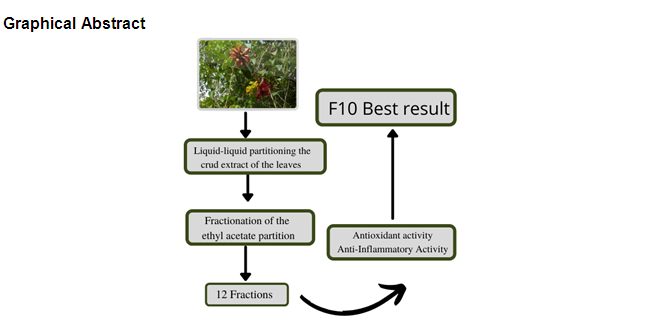
Methodology: Liquid-liquid partitioning was performed, the ethyl acetate partition was eluted in classical liquid chromatography, followed by thin layer chromatography. Antioxidant activity was performed by the DPPH photochlorimetric method and the levels of interleukin (IL‑6), tumor necrosis factor α (TNF‑α), interleukin-10 (IL-10) and nitric oxide (NO) were identified in supernatants of cell cultures.
Results: Fractions F4, F5 and F10 showed antioxidant activity. The F10 fraction indicated efficient anti-inflammatory activity by the production of IL-10 and nitric oxides. Fractions F4, F5 and F9 stimulated the production of IL-6 and TNF-α.
Conclusion: These results indicate a possible synergistic action of the extract and the partition of ethyl acetate, since after fractionation the potential presented in previous studies was lower.
Keywords: Diplopterys, nitric oxide, inteleukin-10, Interleukin-6, tumor necrosis factor-α, chromatography, antioxidant, anti-inflammatory, malpighiaceae