GC–MS Profiling and Pharmacological Implications of Bioactive Compounds in Holarrhena antidysenterica Bark Extract
Kavyarani Rathod
Department of Biotechnology, Gulbarga University, Kalaburagi – 585106, Karnataka, India.
Jayasimha Rao
Department of Internal Medicine, Division of Infectious Diseases, Carilion Clinic, Virginia Tech Carilion School of Medicine, Roanoke, VA 24014 USA and Center for Emerging, Zoonotic, and Arthropod-borne Pathogens, Virginia Tech, Blacksburg, VA 24061, USA.
Chandrakanth Kelmani R *
Department of Biotechnology, Gulbarga University, Kalaburagi – 585106, Karnataka, India.
*Author to whom correspondence should be addressed.
Abstract
Background: Holarrhena antidysenterica (L.) is a medicinal plant widely recognized for its therapeutic applications in traditional medicine. It is commonly used to treat gastrointestinal disorders, infections, and inflammatory conditions. The bark is traditionally considered the most potent part of the plant.
Aim of the Study: While its pharmacological properties have been explored, a detailed GC-MS-based analysis of the bark extract remains limited. This study aims to identify and characterize the volatile and semi-volatile bioactive compounds in the 80% ethanol extract of H. antidysenterica bark using Gas Chromatography–Mass Spectrometry (GC-MS).
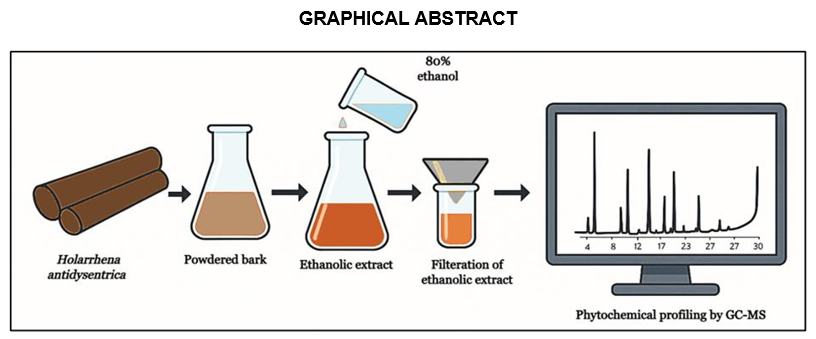
Materials and Methods: The bioactive compounds from the bark were extracted using 80% ethanol via maceration and subjected to GC-MS analysis using an Agilent 8890 GC system coupled with a 5977 MSD. The separation was performed on an HP-5ms Ultra Inert capillary column, with helium as the carrier gas. Compound identification was achieved by matching mass spectra with the NIST17 library.
Results: GC-MS analysis identified 15 bioactive compounds, including phenolic acids and derivatives (trans-cinnamic acid, vanillic acid, p-coumaric acid), apocynin, sterols (γ-sitosterol), and fatty acids and esters (n-hexadecanoic acid, 9,12-octadecadienoic acid, ethyl ester). These compounds are known for their antioxidant, antimicrobial, anti-inflammatory, and pharmacological properties, reinforcing the medicinal value of H. antidysenterica.
Conclusions: This study provides a detailed GC-MS profile of H. antidysenterica bark extract, highlighting its bioactive potential in pharmaceuticals and nutraceuticals. The presence of phenolic acids, sterols, and fatty acids suggests its therapeutic relevance. Further in vitro and in vivo studies are recommended to validate its pharmacological effects.
Keywords: Holarrhena antidysenterica, GC-MS analysis, phytochemical profiling, bioactive compounds, bark extract, ayurvedic medicinal plant